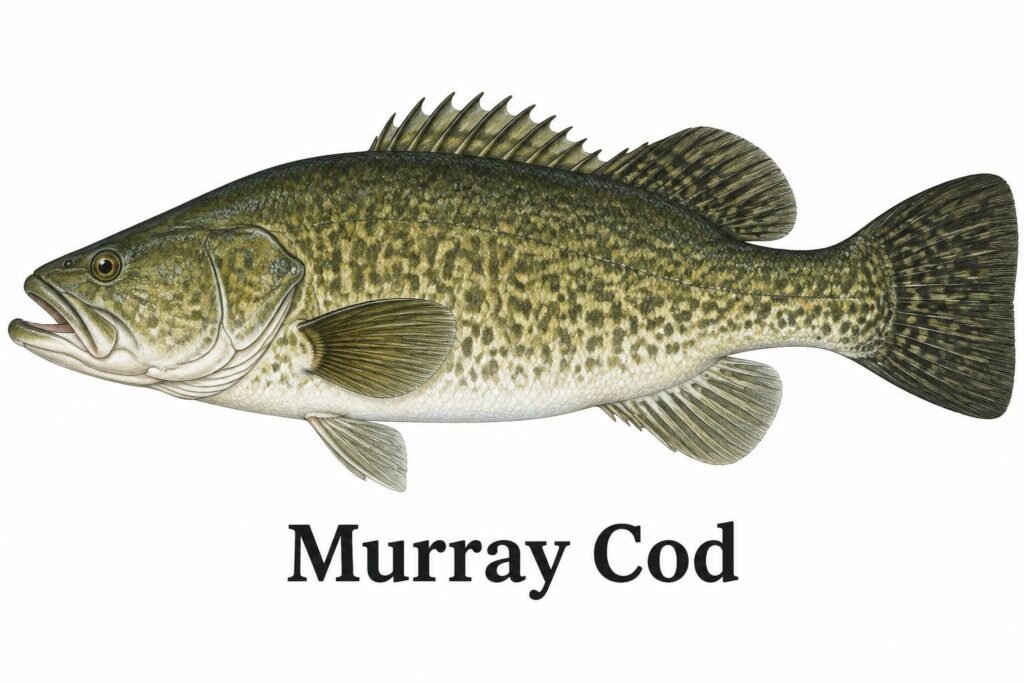
If there is one fish that captures the imagination of Australian freshwater anglers, it is the Murray cod. Massive, powerful and unmistakably Australian, the Murray cod is the largest freshwater fish in Australia and one of the most iconic species found anywhere in the Murray–Darling Basin.
For generations, anglers have travelled the rivers, creeks, lakes and reservoirs of southeastern Australia chasing these fish. Today, extensive stocking programs by the Victorian Fisheries Authority (VFA) and other fisheries agencies are helping create new Murray cod fishing opportunities while supporting the recovery of wild populations.
What is a Murray cod?
The Murray cod, Maccullochella peelii, is a large predatory freshwater fish belonging to the family Percichthyidae.
Despite its name, it isn’t a member of the true cod family found in the ocean.
Murray cod are generally olive-green to yellowish in colour, with darker mottling over the body and head. They have a distinctive broad head, large mouth and concave snout.
They are apex predators in many of the waterways they inhabit, feeding on fish, yabbies, crustaceans, frogs and other aquatic animals. Larger Murray cod have even been recorded taking birds, reptiles and terrestrial animals.
For anglers, however, it is the fish’s combination of size, strength and aggression that makes it so special.
The Murray cod’s Aboriginal history
Long before European settlement, Murray cod were an important part of Aboriginal culture and food systems throughout the Murray–Darling Basin.
The species has numerous Aboriginal names, including Goodoo, Ponde and Pondi.
Murray cod also feature prominently in Aboriginal cultural stories. In one well-known tradition, a giant Murray cod escaped fishermen and travelled down the river, creating the bends and waterways of the Murray River as it went.
The fish therefore isn’t simply another species inhabiting the Murray–Darling Basin. It has a cultural history extending back thousands of years.
European discovery and the name “Murray cod”
European explorers encountered enormous numbers of native fish in the rivers of southeastern Australia.
One remarkable early account comes from explorer John Oxley, who recorded in 1817 that one man caught 18 Murray cod from the Lachlan River in less than an hour. Most weighed around 7–13 kg, while one was estimated at approximately 32 kg.
The scientific name Maccullochella peelii was established in the 19th century, while the common name “Murray cod” became associated with the species because of its abundance throughout the Murray River system.
Historical records suggest that Murray cod were once considerably more abundant and that very large fish were much more common than they are today.
How big can Murray cod get?
This is where Murray cod become truly extraordinary.
The Victorian Fisheries Authority states that Murray cod can reach approximately:
Length: up to 1.8 metres
Weight: up to 113.5 kg
Most Murray cod caught by recreational anglers are obviously much smaller. VFA says fish commonly reach around 55–65 cm and 2–5 kg, although fish in larger river systems can grow dramatically bigger.
The legendary 113.5 kg Murray cod
The commonly cited largest Murray cod ever recorded was approximately:
1.8 metres long
113.5–113.6 kg (250 lb)
The fish was reportedly caught in the Barwon River near Walgett in northwestern NSW in 1902.
There is an interesting historical qualification, however. The 113.6 kg record is based on historical reporting rather than a modern scientifically verified specimen. Later researchers have pointed out that the famous 250-pound fish was reported many years after the alleged capture, and the original evidence is limited.
Nevertheless, the 113.5/113.6 kg figure remains the size commonly cited by government fisheries and scientific references. The Australian Government’s Murray cod background material also records the reputed maximum of 1.8 m and 113.6 kg.
Interestingly, the largest Murray cod for which physical evidence has been reported is considerably smaller, which makes the legendary 113 kg fish an intriguing part of Murray cod history.
Where are Murray cod found?
Murray cod are endemic to the Murray–Darling Basin.
Their natural distribution extends through:
- Victoria
- New South Wales
- South Australia
- Queensland
- Australian Capital Territory
They occur throughout much of the Murray–Darling drainage, although their distribution is more limited in some upper tributaries.
Victorian Murray cod waters
In Victoria, important Murray cod waterways include:
- Murray River
- Goulburn River
- Campaspe River
- Loddon River
- Broken River
- Broken Creek
- Ovens River
- Gunbower Creek
- Avoca River
- Kiewa River
- Lake Eildon
- Lake Eppalock
- Cairn Curran Reservoir
- Rocklands Reservoir
- Lake Nillahcootie
- Hume Lake
- Waranga Basin
- Lake Mulwala and connected Murray River waters
Murray cod have also been introduced into a number of Victorian waters where they don’t naturally occur, including selected lakes and urban fisheries.
Rivers vs lakes – where do Murray cod live?
Murray cod are particularly associated with structure.
Look for:
- submerged logs
- large snags
- deep holes
- undercut banks
- rock walls
- steep banks
- shaded water
- deep bends
- submerged trees
VFA research on the Murray River found an especially strong association between Murray cod and submerged timber. Radio-tracking research found that around 80% of monitored fish were resting within one metre of a snag.
This explains one of the golden rules of Murray cod fishing:
Find the structure and you may find the cod.
Murray cod can also live and breed in lakes and reservoirs when suitable habitat and environmental conditions are available.
What happened to Australia’s giant cod?
Unfortunately, the abundance of Murray cod declined dramatically following European settlement.
The decline wasn’t caused by one single factor.
It was associated with a combination of:
- commercial fishing
- recreational fishing pressure
- removal of river timber
- dams and weirs
- altered river flows
- habitat degradation
- barriers to fish movement
- cold-water releases from dams
- pollution
- major environmental events
- changes to breeding and recruitment
The Australian Government’s national recovery plan describes a substantial decline in Murray cod abundance since European settlement, particularly over the past 70 years.
One particularly striking example was the removal of river snags.
Between 1865 and 1914, one snag boat reportedly removed an average of 300–400 snags every month from the Murray and Murrumbidgee system. Another period of snag removal resulted in millions of logs being removed.
For a fish that relies heavily on submerged timber for shelter, feeding and spawning habitat, the consequences were significant.
The decline of the commercial Murray cod fishery
Commercial fishing also played a major historical role.
In Victoria, commercial Murray cod catches were highest around 1954–55 to 1960–61, when approximately 10–15 tonnes per year were recorded.
During the following decade the average fell to around 1.5 tonnes per year, before becoming negligible.
The decline was even more dramatic in parts of the Murray–Darling Basin.
In South Australia, annual commercial landings reportedly fell from around 140 tonnes in the late 1950s to less than 10 tonnes during the 1970s and 1980s.
Today, commercial fishing for Murray cod is prohibited in the Murray–Darling Basin.
Victoria’s Murray cod stocking program
This is where things get exciting for recreational anglers.
Victoria has been stocking Murray cod into rivers and lakes for decades. Hatchery-produced Murray cod have been stocked in Victorian waters since at least 1979–1981, depending on the particular program or waterway.
In recent years the scale of the program has increased dramatically.
2024–25 stocking
According to the VFA’s stocking figures, Victoria stocked:
4,014,820 Murray cod
during the 2024–25 stocking program.
That was the largest number of any individual fish species in Victoria’s 10-million-fish program.
The fish were released into waterways throughout the state.
Some of the Victorian waters stocked with Murray cod
The VFA’s 2024–25 stocking records show just how extensive the program has become.
Loddon–Mallee region
Some examples include:
| Waterway | Murray cod stocked 2024–25 |
|---|---|
| Lake Eppalock | 447,430 |
| Cairn Curran Reservoir | 259,230 |
| Kangaroo Lake | 321,370 |
| Loddon River | 197,060 |
| Campaspe River | 149,910 |
| Laanecoorie Reservoir | 60,000 |
| Gunbower Creek | 72,080 |
| Lindsay River | 60,000 |
| Avoca River | 33,000 |
| Upper Coliban Reservoir | 76,010 |
| Lauriston Reservoir | 20,000 |
| Charm Lake | 20,000 |
| Boga Lake | 50,090 |
These are actual VFA stocking figures for the 2024–25 season.
Hume region
The VFA’s Hume-region figures included:
| Waterway | Murray cod stocked 2024–25 |
|---|---|
| Lake Eildon | 450,480 |
| Hume Lake | 257,000 |
| Goulburn River | 220,980 |
| Broken River | 82,630 |
| Nillahcootie Lake | 60,000 |
| Broken Creek | 45,420 |
| Buffalo Lake | 40,000 |
| Corryong–Jerimal Creek | 25,000 |
| Kiewa River | 15,000 |
| Ovens River | 10,000 |
The Hume region alone received more than 1.2 million Murray cod during 2024–25.
Lake Eildon – one of Victoria’s major Murray cod fisheries
Lake Eildon has become one of Victoria’s best-known stocked Murray cod fisheries.
During 2024–25, the VFA recorded 450,480 Murray cod stocked into Lake Eildon.
And the stocking hasn’t stopped.
A March 2026 VFA update reported that approximately 900,000 Murray cod were being stocked between Lake Eildon and Rocklands Reservoir during the 2025–26 season, with more than 400,000 already delivered to Eildon and approximately 500,000 destined for Rocklands.
That makes these two waters particularly interesting destinations for anglers chasing a stocked Victorian cod.
Rocklands Reservoir – another major cod destination
Rocklands Reservoir in western Victoria has developed into another significant Murray cod fishery.
The VFA reported more than 570,000 Murray cod stocked there during 2024–25.
The 2025–26 program was even larger, with approximately 500,000 additional Murray cod planned for Rocklands.
Rocklands is also significant because the VFA has established year-round Murray cod fishing there.
More year-round Murray cod fishing in Victoria
Traditionally, Murray cod fishing in many Victorian waters has been subject to a closed season from 1 September to 30 November.
However, the rules have changed for a number of stocked fisheries.
The VFA has introduced year-round Murray cod fishing in:
- Lake Eildon
- Rocklands Reservoir
- Taylors Lake
- Lake Charlegrark
- Lake Bellfield
- Lake Eppalock
- Cairn Curran Reservoir
- Lake Nillahcootie
Further changes in 2026 also made additional small lakes and Arcadia Pondage year-round Murray cod fisheries.
Important: Murray cod fishing regulations can change, so anglers should always check the current VFA rules before fishing.
The current Victorian rules specify a 55–75 cm legal size range, with different bag limits applying to rivers and specified lakes/impoundments.
Victoria’s 2026–27 stocking plans
The VFA’s published 2026–27 draft stocking plan proposes approximately:
2,976,100 Murray cod
to be stocked across Victorian waters.
The draft plan also includes ongoing large-scale stocking of Rocklands Reservoir, along with Murray cod releases into numerous rivers, lakes and reservoirs.
Because this is a draft plan, anglers should check the VFA’s final stocking information rather than assuming every proposed release will occur exactly as listed.
Why does Victoria stock Murray cod?
Stocking has several purposes.
In some waters, stocking is intended to create or enhance recreational fishing opportunities.
In other waters, stocking forms part of efforts to support native fish populations.
The distinction is particularly important between lakes and rivers.
Some Victorian reservoirs have relatively low natural Murray cod recruitment and are therefore heavily dependent on stocking to maintain their recreational fisheries. The VFA describes Lake Eppalock, Cairn Curran and Nillahcootie as examples of fisheries substantially maintained through stocking.
Rivers are different.
Healthy river systems can support natural recruitment, meaning Murray cod can successfully spawn and produce young fish themselves.
Monitoring has shown encouraging increases in catch rates in several Victorian rivers, including the Broken Creek, Broken River, Campaspe, Goulburn, Gunbower Creek and Ovens River.
Victoria’s hatcheries
A major part of the stocking program is the Arcadia Native Fish Hatchery near Shepparton.
In October 2025, the Victorian Fisheries Authority announced the completion of a major expansion of the hatchery.
The facility went from 32 production ponds to 125, significantly increasing its capacity to produce native fish, including Murray cod and golden perch.
The expansion is designed to help supply millions of native fish for stocking Victorian waterways.
For Victorian anglers, that means the Murray cod fishing opportunities being created today are backed by a substantial long-term fish production program.
Why Murray cod are such a special fish to catch
There is something different about catching a Murray cod.
They’re not necessarily the fastest fish in Australia’s freshwater systems.
They’re not always easy to find.
And they certainly don’t feed every time an angler puts a lure in front of them.
But when a big cod decides to eat, things can happen very quickly.
A large lure disappears into an enormous mouth, the rod loads up and suddenly the fish is heading straight for the nearest snag.
That combination of size, power, aggression and habitat has created a fishing culture around Murray cod unlike almost any other Australian freshwater species.
The future of Murray cod fishing
The story of the Murray cod is one of decline, protection and recovery.
The species is still listed as Vulnerable under the Commonwealth EPBC Act, reflecting the continuing conservation challenges facing populations across its range.
At the same time, there are genuine positive signs.
Victoria’s stocking program is releasing millions of Murray cod, while monitoring has identified increased catch rates in a number of rivers.
The combination of:
better habitat management + improved river flows + fish passage + responsible fishing + stocking + natural recruitment
is helping create a future in which Murray cod can continue to be one of Australia’s great freshwater fishing experiences.
And perhaps one day, somewhere along a Victorian river or reservoir, an angler will connect with another truly enormous Murray cod.
🎣 Where should you go Murray cod fishing?
For Victorian anglers, some of the waterways worth researching include:
Lake Eildon • Rocklands Reservoir • Lake Eppalock • Cairn Curran Reservoir • Lake Nillahcootie • Goulburn River • Campaspe River • Loddon River • Murray River • Gunbower Creek • Broken River • Broken Creek • Ovens River
The VFA’s stocking database is the best place to check where, when and how many fish have actually been stocked, rather than relying on old fishing reports.
VFA Fish Stocking information and stocking database
Real Strike Fishing
The Murray cod isn’t just another Australian fish. It’s a symbol of our rivers, our fishing culture and the pursuit of that one unforgettable strike.
Respect the fish. Respect the water. Chase the strike.
This article uses VFA and Australian Government fisheries information available in September 2026. Stocking schedules, fishing regulations and closed seasons can change, so anglers should check the current VFA regulations before fishing.